
James City Three-Day Release Source
VPRJ has no government page listing all releases from the prior three days. Its online product is a Current Inmate List, not an archive. It does not offer a released tab, a 72-hour filter, or a stated retention period for old entries. The site also gives no update cadence. Those limits prevent a reliable three-day list from being reconstructed by taking names that disappear.
The regional structure adds another issue. VPRJ holds people from James City County, Williamsburg, York County, and Poquoson. A request for an existing release log should identify exact dates and ask for James City County-origin bookings. A request about one named person should include the known booking range, aliases, and originating jurisdiction. That scope helps VPRJ find a record without creating a new compilation.
Check James City Three-Day Releases
Set the period first. Use calendar dates and, when needed, the start and end times. A phrase such as "the last three days" can shift while the request is processed. The most useful official response is an existing VPRJ release log for that defined range, if one is maintained and releasable. For one person, the booking-and-release summary is more precise.
- Write down the exact three-day range and the James City County connection.
- Check the VPRJ current list to learn whether the person is listed now. Save relevant jail and court identifiers.
- Search Virginia Jail VINE for a reported event tied to Virginia Peninsula Regional Jail.
- Review the correct Williamsburg/James City County court case for an order, disposition, or sentence that explains the change.
- Email FOIA@vprj.org for the existing release log or a named booking-and-release summary. Ask for the release date, time, disposition, and receiving agency.
- Search VADOC, BOP, or ICE when the facts suggest that custody moved to another system.
The narrower Released Last 24 Hours process is better when the event likely occurred today. The three-day method is designed for catch-up work and date-bounded requests, not a live same-day watch.
James City Three-Day Record Fields
No public feed supplies a fixed field set. Instead, name the fields sought in the request. The table below reflects the release-record details documented in the James City County research, not a promise that every field will be disclosed in every case.
| Field | Why it matters across three days |
|---|---|
| Name, aliases, jail number | Separates people with similar names and ties events to one booking. |
| Booking date and time | Shows which custody episode ended during the range. |
| Originating agency and court | Distinguishes James City County matters within the regional jail. |
| Release date and time | Places the event within the defined period. |
| Release reason or disposition | May identify bond, time served, court order, discharge, or transfer. |
| Releasing authority | Points to the court order or other authority that ended the hold. |
| Destination, receiving agency, detainer | Helps distinguish community release from continued custody. |
A bond release does not end the criminal case. Time served means the credited custody term was met. Discharge can end confinement while another part of a sentence remains. Transfer means the custodian changed. A detainer can cause another agency to take custody after VPRJ processing ends.
A release-range request should state whether it seeks all VPRJ events tied to James City County or one identified person. The first depends on whether the jail already keeps a releasable log that can be filtered without creating a new record. The second can name the booking, aliases, court, and approximate dates. Virginia FOIA gives access to existing public records, but it does not require the authority to answer questions or construct a custom report.
Institutional retention is not the same as online display. VPRJ may retain booking and release material even though a past name is no longer searchable on the public roster. The lack of a web archive does not prove that no record exists. It means the request must go to the custodian and may be subject to redaction or an exemption.
James City Weekend Release Checks
A three-day range is useful after a weekend or holiday because it avoids guessing which day the custody event appeared in an agency system. Still, VPRJ publishes no special weekend release schedule and no public rule for roster updates. Do not claim that a court order, VINE alert, or dropped roster entry occurred at the same moment as physical release.
Use exact timestamps when sources provide them. A court may enter an order before jail staff clear other holds and complete release steps. VINE reports the event supplied by the participating source. A VPRJ record supplies the jail's completed event. If the timestamps differ, preserve each with its source rather than forcing them into one time.
For someone whose name is not on the list after the weekend, the court case may explain the legal authority. It cannot by itself prove the precise time the person left the building. The VPRJ release or transfer record remains the best source for that point.
Weekend review also benefits from a receiving-agency check. A person who left VPRJ on Friday may appear in a state or federal system later, after intake and data processing. Preserve the times rather than assuming the systems update together. If the event is urgent, direct contact with the correct custodian is more reliable than repeated roster refreshes.
Note: A three-day window catches more possible dates, but it does not cure missing or delayed source data.
James City Release Verification Order
Use Virginia Jail VINE first when a registration or current search returns a VPRJ event. Next seek the VPRJ booking-and-release record or an existing release log. Then read the court order that supplies the legal reason. Finally, search likely receiving systems. A no-match on the current roster stays at the bottom of the evidence chain.
VPRJ publishes separate contact routes for the work. Records is 757-820-3908, Intake/Release is 757-820-3906, and the formal request address is FOIA@vprj.org. Ask staff to identify the correct record or channel. Do not ask them to infer why someone vanished or to disclose a future date, because VPRJ says that date is available only to the inmate.
The VADOC locator accepts a name or seven-digit DOC number and can show state custody or community supervision. It is not an archive of every former regional-jail detainee. BOP covers federal prison records. ICE's locator covers immigration detention within its own limits. Search the system that may have received the person.
For an older case, begin with the court disposition and a direct VPRJ request. VINE is strongest when registration occurred during custody. A fully discharged person may also have less public information in the state locator. Use dates and identifiers from one source to narrow the next search without assuming that every database keeps the same history.
Why James City Entries Disappear
The current roster answers one narrow question. It shows who the system lists in custody when checked. Once a name is absent, it does not disclose whether the person went home, moved to a state facility, entered another jail, used an alias, or was affected by a technical update. No published post-release visibility period fills that gap.
The official VPRJ release-date FAQ adds a second limit: a release date is made available only to the inmate. The screenshot below documents the jail's official release-date position, not a public 72-hour feed.
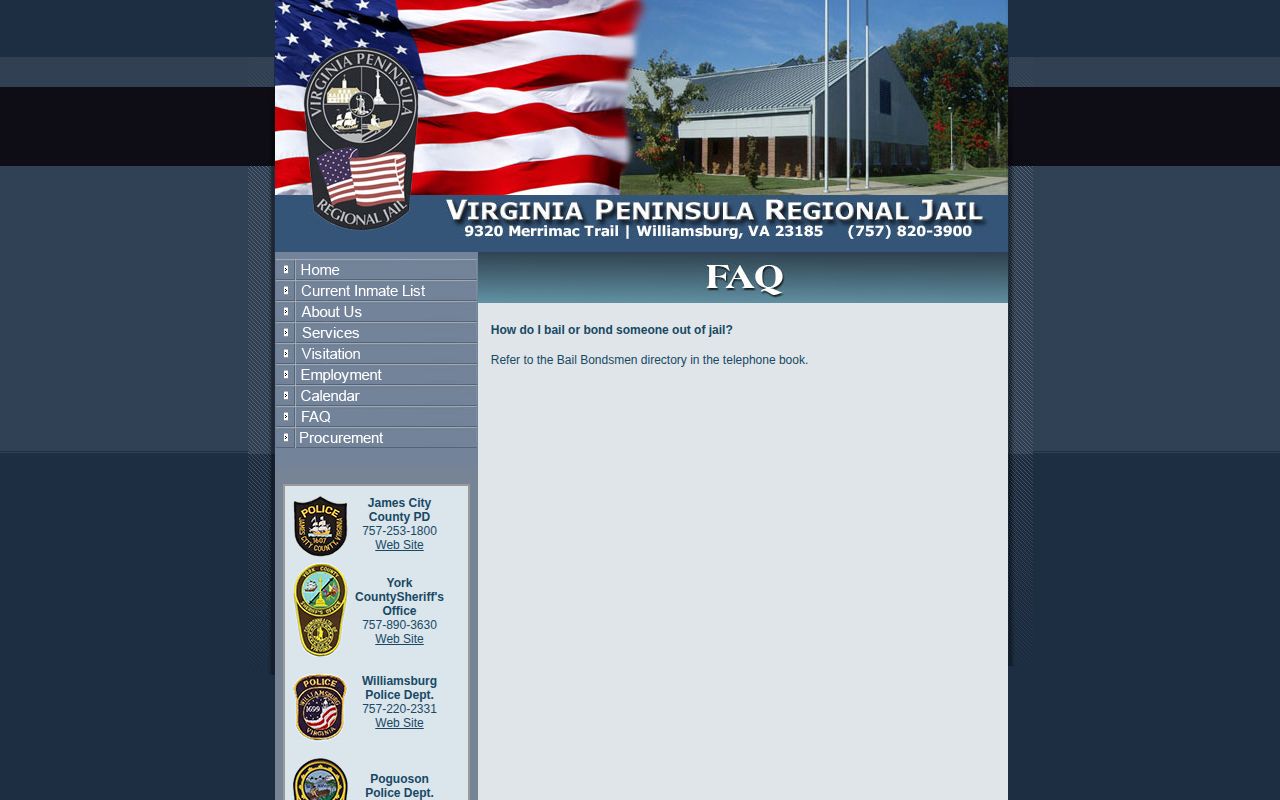
That policy makes post-event records, VINE events, and court records central to a James City County three-day check. It also means an unsourced claim about a future exit time should not be repeated as an official release date.
Read James City Release Outcomes
Leaving VPRJ can describe two very different outcomes. A community release follows bond, time served, sentence completion, dismissal, or another lawful order when no other hold keeps the person confined. A transfer also ends the VPRJ episode, but custody continues with VADOC, another jail, federal authorities, or immigration authorities.
Supervision is another layer. A person may leave confinement and begin probation, parole, or local community corrections. Parole is conditional release for an eligible population. Probation is supervision ordered by a court, often tied to a conviction or suspended sentence. A release record should therefore be read beside the sentencing order and any public supervision result.
- Community release
- The person leaves confinement without transfer to another custodian.
- Transfer
- One agency's custody ends because another agency takes control.
- Discharge
- A sentence or custody component ends, though other legal duties may remain.
- Detainer
- A notice or hold from another authority that can affect release.
Note: The release disposition, not roster absence, determines whether a James City County detainee returned to the community.