
James City Projected Versus Actual Release
A projected release date is a computed or anticipated point based on the sentence information available at the time. An actual release date records when custody ended or changed. Those dates may differ. Jail staff must account for the signed order, credit for qualifying prior confinement, concurrent or consecutive directions, mandatory minimums, sentence credits, and other active cases. VADOC performs a parallel but distinct computation for people under state authority.
Pretrial custody works differently. A person awaiting disposition at Virginia Peninsula Regional Jail does not have a sentence end date to calculate. Bond may permit release once its terms are met, a judge may enter a new order, or another detainer may keep the person confined. Even a dismissal does not prove immediate physical release when another hold exists. The court record explains legal authority, while the VPRJ record documents release processing.
Scheduled versus actual: Treat every future date as subject to change. Only a release entry from the custodian establishes the physical custody event.
A transfer also matters. Leaving VPRJ for VADOC, another jail, federal custody, or immigration custody is not community release. Check the receiving system whenever the regional-jail entry disappears.
Find a James City Release Date
Start with the custodian, not just the arrest location. VPRJ holds James City County arrestees and local sentenced people, but it is a regional authority rather than a sheriff-operated jail. The VADOC Inmate and Supervisee Locator is appropriate for a state-responsible prisoner or supervisee. It accepts a seven-digit DOC number or a name. Search results should be read with the court order because the public date label can reflect state computation rather than a local-jail sentence.
Use this sequence for a named person:
- Identify the sentencing court and obtain the active commitment or sentencing order.
- Check the VPRJ current list only to learn whether the person is presently listed there.
- For state authority, search VADOC by DOC number when known and record the exact date label shown.
- For a local sentence, have the inmate use VPRJ's authorized release-date channel and preserve the underlying court order.
- Check for other cases, detainers, transfers, or amended orders that may affect the physical destination.
- After release, request the booking-and-release summary to confirm the actual event and disposition.
The broader James City County released-inmate lookup explains how VINE, court records, VADOC, and a VPRJ records request fit together after a person is no longer on the current roster. A no-match is only a lead.
James City Local Sentence Credits
For a qualifying local misdemeanor sentence, Virginia Code § 53.1-116 supplies the key framework. A person sentenced to twelve months or less, when not serving a mandatory minimum, may earn one day of good-conduct credit for each day served without a jail-rule violation. Qualifying pretrial confinement can count. The statute also permits five additional days per thirty days for specified institutional work, classes, or local workforce programs when those options exist and credits are granted under written policy.
That rule does not create a safe “divide the sentence by two” formula. A mandatory minimum, a felony credit limit, more than one case, concurrent or consecutive terms, an outside hold, or lost credit can change the result. VPRJ did not publish a detailed local credit policy in the reviewed sources. The signed order and the jail's actual computation control.
The official Virginia law page shows the local-jail record and good-conduct-credit provisions used in a James City County release-date inquiry.
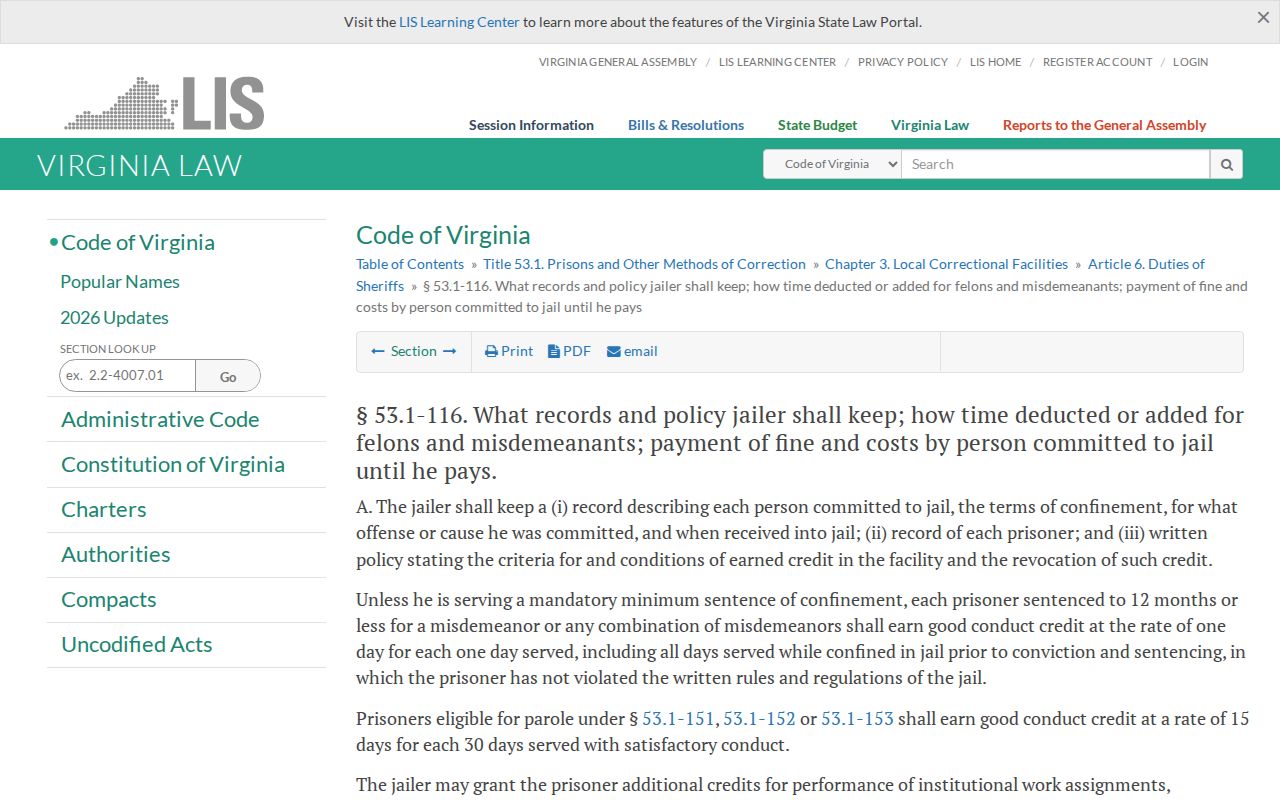
Read the current statute with the specific sentence rather than turning its maximum credit into a promised release date.
Note: Time credited before sentencing, program credit, and good conduct are separate inputs and may not all apply to the same person.
Virginia State Release-Date Credits
State-responsible sentences use VADOC time computation and the earned-sentence-credit article. Section 53.1-202.2 defines applicability and exclusions. Section 53.1-202.3 sets credit classes and rates. The common claim that a Virginia prisoner always serves about eighty-five percent is too broad. Under the traditional ESC-1 baseline, the operative rate is zero to 4.5 credit days for each thirty days served.
Eligible ESC-2 people can earn up to fifteen days per thirty days at Level I, 7.5 at Level II, 3.5 at Level III, and none at Level IV. Behavior and program requirements apply, and many offenses are excluded or restricted. The governing version may depend on the offense date. A precise James City County projected release date therefore requires the actual offense, sentence, applicable credit system, earned class, and certified jail credit.
The official earned-credit rates are shown in the captured source below.
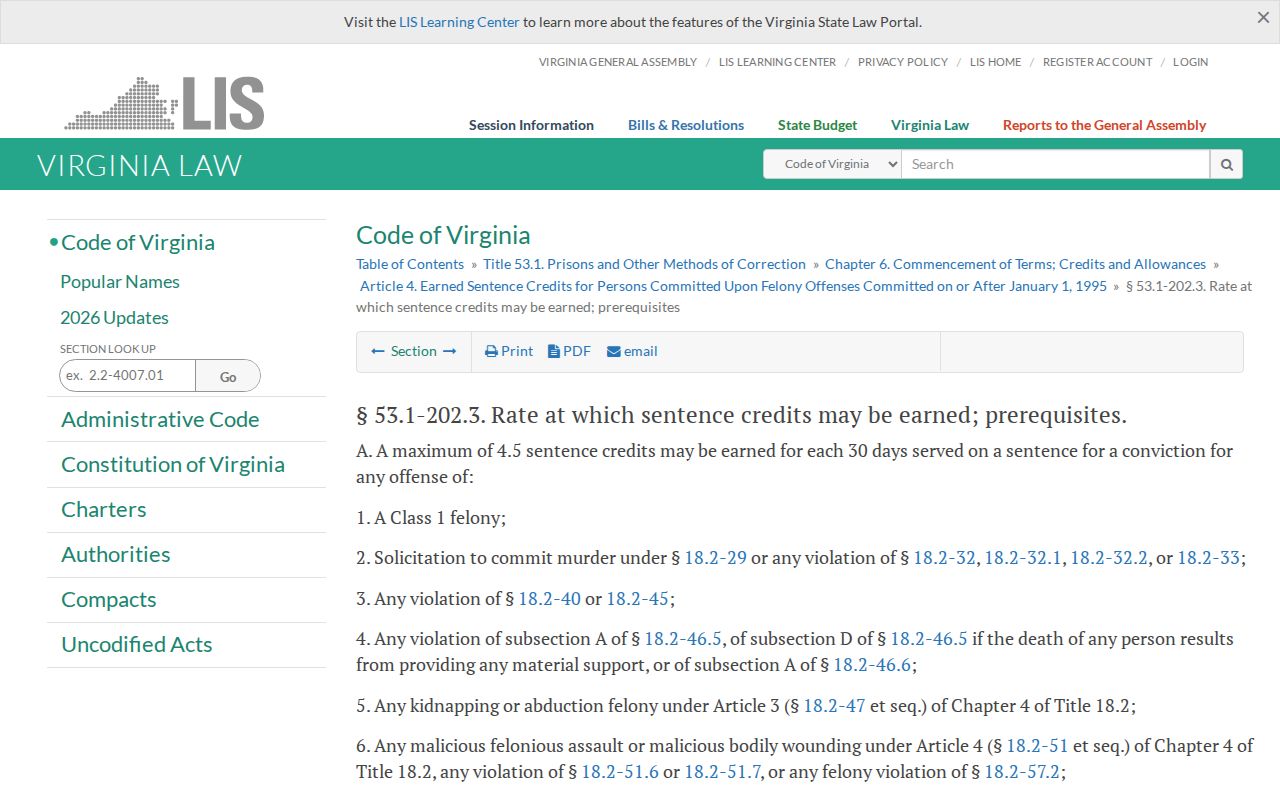
The table of rates is only one part of the calculation. Eligibility and the person's current class must be verified before applying a rate.
Offense dates can place two people with similar sentence lengths under different credit rules. VADOC must also receive a certified record of jail time already served. When a result seems inconsistent with the order, compare the commitment, offense date, credit certification, and current class before treating the displayed date as wrong. A records request should seek the public time-computation summary, not a full confidential institutional file.
VADOC James City Release-Date Search
The VADOC locator's scope extends beyond state prisons. It may include people under community supervision, people in institutional hospitals, and some state-responsible people who remain in a local or regional jail. That overlap explains why a person can appear in VADOC and VPRJ at the same time. It does not prove a transfer to a state prison. Read the location and custody category as well as the release-date field.
A DOC number is the strongest search key because names can collide. The live form accepts a seven-digit DOC ID or a name. A name search requires at least the first three letters of the first name and a full last name of at least two characters. Optional filters can narrow the candidate set, but each result still needs to be checked against lawful public identifiers.
| Locator control | How it helps |
|---|---|
| Seven-digit DOC number | Targets a known state corrections identity. |
| First and last name | Finds candidates when the DOC number is unknown. |
| Location | Helps distinguish a state institution, district, or other placement. |
| Race, gender, and age range | Optional filters can narrow same-name candidates. |
| Displayed date label | Must be copied exactly and treated as current only when checked. |
VADOC says its data receives daily updates but may still be inaccurate or out of date. A fully discharged person may no longer appear because the locator is not promised as a permanent archive of every former prisoner. When the result is absent, use VADOC's records channel and the sentencing court rather than assuming the sentence or supervision ended.
Why James City Release Dates Move
A projected date can change without an error. Courts amend orders. Staff receive new credit certifications. A later case adds time. Earned-credit class changes or discipline restores days to serve. Parole action may affect a person within an eligible population. Administrative review can correct a prior calculation. The date is a live output of those inputs, so record the label and the date checked whenever relying on a VADOC result.
| Change | Effect on release-date review |
|---|---|
| Amended court order | May change the active term, concurrency, or credit direction. |
| New or corrected jail credit | Changes how much time is left to serve. |
| Earned-credit class or discipline | Can add or remove credit under the applicable system. |
| Another sentence | May add a consecutive term or alter the controlling date. |
| Detainer or receiving agency | May change the destination even if the present term ends. |
| Parole action | Applies only to a legally eligible population and does not by itself prove the release moment. |
Virginia generally abolished discretionary parole for felony offenses committed on or after January 1, 1995, though legacy and statutory exception groups remain. Modern state release dates often reflect sentence credits rather than an expected Board grant. A detainer is a request or legal basis for another authority to take custody. It can mean the person leaves one facility on time yet does not return to the community.
Confirm James City Actual Release
For local custody, Virginia Jail VINE can report a status change supplied by VPRJ. Registration works best while the person is still in participating custody. A notice is useful evidence, but the jail's booking-and-release record remains the source for release date, time, disposition, and any receiving agency. The VINELink Release Check covers the named-person search and notification steps.
State-prison notifications use VADOC's separate process. A local Jail VINE registration does not automatically follow a transfer into VADOC. For a state date, compare the locator with VADOC time computation and the court order. After the event, seek the releasable discharge or custody record. For VPRJ, send a focused request to FOIA@vprj.org or call Records at 757-820-3908 for routing.
A useful request names the person, approximate booking and release range, and James City County as the originating jurisdiction. Ask for the existing booking-and-release summary, actual release date and time, release disposition, releasing authority, and destination if transferred. Electronic delivery and an advance cost estimate help keep the request precise. No fixed VPRJ fee was found, so do not assume a price.
VPRJ Release Date Privacy Rule
VPRJ's official release-date FAQ says a release date is made available only to the inmate. That local rule changes the practical search path. A friend or family member should not expect a public telephone forecast from Intake/Release. The proper route is court-order review, a VINE notification set while the person is in custody, and a post-event release-record request.
The VPRJ release-date FAQ is visible in the official capture below.

That restriction does not erase the underlying sentence or release records. It limits the public future-date channel, so the inmate, court record, and later event record each serve a distinct role.
Weekend and holiday claims need the same caution. No VPRJ rule was found that promises a Friday release whenever a term ends on a weekend or holiday. Virginia laws governing some nonconsecutive or weekend sentences are not a blanket early-release rule. Ask VPRJ about the exact order rather than moving the date by assumption.
Note: A forecast withheld from a caller and an actual release entry requested after the event are different records with different timing.